
A heat pump can warm your home in winter and cool it in summer from a single system. For many homeowners in Santa Rosa and across Sonoma County, that combination raises a lot of questions.
If heat pumps keep coming up from neighbors, contractors, or local rebate programs, this guide explains what they are and whether one fits your home. By the end, you’ll understand how heat pumps work, the two main types for local homes, what they cost to run, how long they last, and what quality heat pump installation in Santa Rosa, CA involves.
Key Takeaways
- A heat pump both heats and cools by moving heat rather than burning fuel, which makes it efficient in Sonoma County’s mild climate.
- Two types cover most local homes: ducted air-source heat pumps and ductless mini-splits. The right choice depends on your home’s ductwork and layout.
- Heat pumps often lower monthly energy use, improve room-to-room comfort, and can support cleaner indoor air during smoke season.
- Sonoma Clean Power runs rebate programs for qualifying heat pump systems, and the terms change, so current offers should be confirmed before buying.
- Most heat pumps last 12 to 15 years with regular maintenance, and a professional assessment before installation protects both comfort and budget.
What Is a Heat Pump?
A heat pump is a heating and cooling system that moves heat from one place to another instead of creating heat by burning gas.
- In winter, it pulls warmth from the outside air and brings it indoors.
- In summer, it runs in reverse and moves heat out of your home, the way an air conditioner does.
Even cold outdoor air holds usable heat energy, and a heat pump captures it. A refrigerant circulates through the system, absorbing heat outdoors and releasing it inside during heating mode, then reversing that flow to cool.
Since the system moves heat rather than generating it, it delivers more heating energy than the electricity it draws. Traditional electric resistance heat and gas furnaces can’t match that ratio, which is why heating bills often drop after a switch.
Every system shares a few core parts:
- Outdoor unit – pulls heat in or pushes it out, depending on the season
- Indoor unit – distributes conditioned air through ducts or wall-mounted heads
- Refrigerant lines – carry heat between the two units
- Reversing valve – switches the system between heating and cooling
- Thermostat or controls – set the temperature and mode
Many newer heat pumps use variable-speed (inverter) compressors, which run at low output most of the time and ramp up only when needed. That steady operation holds temperatures more evenly and uses less energy than older systems that cycle fully on and off.
The Two Main Types of Heat Pumps
For most Sonoma County homes, the choice comes down to two options. The right one depends on whether the home has ductwork and how the space is laid out.
Ducted Heat Pumps
A ducted air-source heat pump connects to a home’s existing ductwork and delivers heating and cooling to the whole house through the vents already in place.
For homes replacing an older furnace and central AC, this is often the natural swap, since the ducts stay and only the equipment changes.
Ductwork condition affects performance. Leaky or poorly insulated ducts waste energy and reduce comfort, so an assessment usually includes checking the duct system, not just the equipment.
When the ducts are in good shape, a ducted system provides even, quiet comfort across every room served.
Ductless Mini-Split Heat Pumps
A ductless mini-split uses one outdoor unit connected to one or more wall-mounted indoor heads, with no ductwork involved.
That design fits older homes without ducts, room additions, converted garages, and houses with rooms that never reach a comfortable temperature.
Each indoor head can be controlled separately, which creates zones. One room can run cooler than another, and unused rooms can be dialed back to save energy. Since there are no ducts, a mini-split avoids the energy losses that leaky ductwork causes, which can make it a strong efficiency choice for the right home.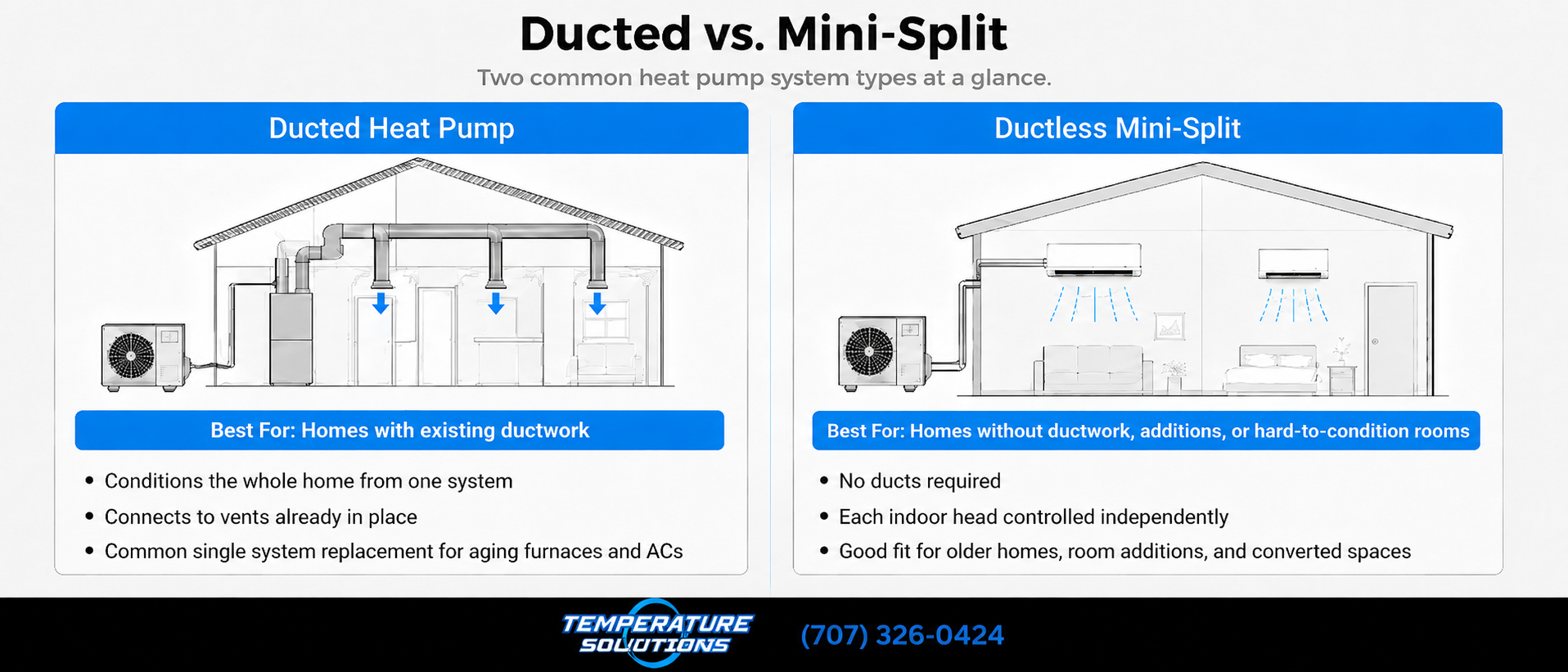
How Local Conditions Affect Heat Pump Performance
Local climate matters more than most homeowners expect, and Sonoma County is close to ideal for this technology.
Mild Winters, Hot Summers
Winters here stay mild and hard freezes are rare, so a heat pump operates at its most efficient through most of the heating season. On the coldest mornings, some systems briefly run a defrost cycle to clear frost from the outdoor coil, and many include a backup heating element for the rare cold snap. In this climate, that backup runs infrequently.
Summers bring real heat waves, and the same system that heated the home in January cools it in July. One piece of equipment, sized for the temperatures the region actually experiences, covers both jobs.
Wildfire Season
During smoke events, indoor air quality drops quickly. A heat pump paired with quality filtration helps keep indoor air cleaner. A few things to know:
- Filter ratings matter. A higher-MERV filter captures finer particles, though the system has to be designed to handle the added resistance.
- A heat pump alone isn’t an air purifier. Homes with serious air quality concerns can pair a heat pump with dedicated indoor air quality services for better results.
Older Homes and Aging Equipment
Many Sonoma County homes run an aging furnace and a window AC unit side by side. A heat pump can replace both at once, which often makes more financial sense than repairing two separate systems approaching the end of their service life.
The Benefits of a Heat Pump
Homeowners choose heat pumps for several practical reasons:
- Lower energy use. Moving heat costs less than making it, so many homes see smaller monthly bills, especially compared with older electric or propane heating.
- One system, two jobs. Heating and cooling from a single system means fewer units to maintain and repair over the years.
- More even comfort. Zoned and ductless options let you fine-tune temperature room by room, and variable-speed operation reduces the hot-and-cold swings older systems cause.
- Cleaner indoor operation. No gas combustion inside the living space, which some homeowners prefer for both safety and air quality.
- Rebate eligibility. Qualifying systems can tap into local programs that reduce the upfront cost.
These benefits depend on correct sizing and installation. An oversized system short-cycles and wastes energy, while an undersized one never keeps up, so the assessment step decides whether a home actually sees these results.
Heat Pump Rebates in Sonoma County
Rebates can meaningfully lower the cost of a new system, and Sonoma County homeowners have local options.
Sonoma Clean Power runs rebate programs for residential and commercial customers in Sonoma and Mendocino Counties who install qualifying energy-efficient equipment, including heat pump heating and cooling systems that meet specific performance requirements.
A few rules are worth knowing before counting on a rebate:
- Heat pump heating and cooling systems must meet specific SEER2 and HSPF2 performance requirements to qualify.
- Program rules, rebate amounts, and eligibility can change at any time.
- Applications must be submitted within 90 days of project completion, and the installation address must be a Sonoma Clean Power account.
- Customers can receive one rebate per equipment type per account.
- New construction generally does not qualify, with an exception for fire rebuilds.
- Customers enrolled in the CARE or FERA bill-discount programs may qualify for a larger rebate covering part of the remaining project cost.
Because the details shift, current terms should be confirmed on the Sonoma Clean Power rebate application page before any purchase. The Temperature Solutions team can also help you understand which equipment is likely to qualify.
How to Read a Heat Pump’s Efficiency Ratings
Two numbers describe how efficient a heat pump is, and understanding them helps you compare systems.
- SEER2 measures cooling efficiency across a season. A higher SEER2 number means the system uses less electricity to cool your home.
- HSPF2 measures heating efficiency the same way. A higher HSPF2 means more heat delivered per unit of electricity.
Higher-rated systems usually cost more upfront, but less to run. The correct target depends on how much you run the system and how long you plan to stay in the home, which is part of what a professional assessment sorts out.
Heat Pump Life Span: What to Expect
Most heat pumps last 12 to 15 years, and some run well past that with good care. Lifespan depends on:
- How well the system was sized and installed
- How often it runs
- Whether it receives regular maintenance
Because a heat pump works year-round rather than seasonally like a separate furnace and AC, upkeep carries more weight. A neglected system wears faster and loses efficiency along the way, while a maintained one holds its performance and reaches the far end of that range.
Correct installation matters just as much: a system that was oversized or connected to leaky ducts often struggles for its entire service life, no matter how well it’s maintained.
How to Maintain a Heat Pump
Good maintenance comes down to steady habits plus one or two professional visits a year.
Homeowner tasks:
- Replace or clean air filters every 1 to 3 months, and more often during smoke season
- Keep the outdoor unit clear of leaves, weeds, and debris, with space around it for airflow
- Watch for changes such as weak airflow, unusual sounds, ice on the outdoor unit outside of a normal defrost cycle, or a jump in the energy bill
Professional tasks during a service visit:
- Check refrigerant levels and inspect for leaks
- Test electrical connections and controls
- Clean the coils and inspect the blower and fan
- Verify the reversing valve and defrost function
- Confirm the system heats and cools to specification
Scheduling this kind of thorough service visit each year is what separates a system that lasts 12 years from one that reaches 15.
When Should You Schedule Maintenance?
For a year-round system, twice a year works well:
- Once before heavy cooling in spring
- Once before heavy heating in fall
That timing catches small issues ahead of the seasons that push the system hardest.
Schedule a check sooner at the first sign of:
- Weak airflow
- Uneven temperatures
- Strange noises
- Rising energy bills
Acting early is far cheaper than waiting for a failure during a heat wave or a cold snap.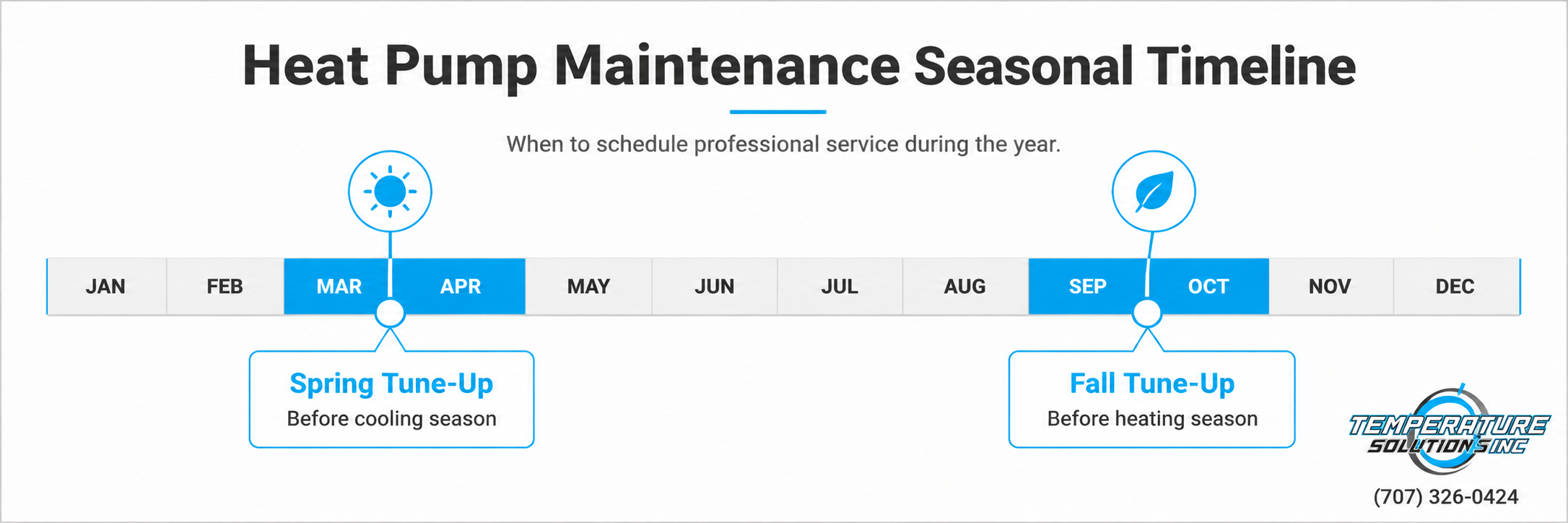
Why a Professional Assessment Matters Before You Choose
Choosing a heat pump is not a catalog decision. The right system depends on the home’s:
- Square footage
- Insulation
- Windows
- Ductwork
- Layout
- Electrical panel capacity
A proper assessment includes a load calculation, which measures how much heating and cooling the home genuinely needs. Skipping this step risks an oversized system that short-cycles and wears out early, or an undersized one that never keeps up.
Before any heat pump installation in Santa Rosa, CA, this measurement determines whether the home will stay comfortable and efficient for the next decade.
What to Look for in a Local Heat Pump Contractor
Installation quality decides how well a heat pump performs, so the company matters as much as the equipment. Strong signs to look for:
- Proper licensing and insurance. In California, ask for the contractor’s license number. The Temperature Solutions license is #1084886.
- An honest assessment. A trustworthy installer measures the home’s load before quoting, rather than pushing a single default answer.
- Local knowledge. A company working across Sonoma County understands the regional climate, older housing stock, and local rebate programs.
- Transparent options. A good installer explains the tradeoffs between ducted and ductless systems and between price points, not just the most expensive path.
- Clear communication. You deserve plain-language answers about what you’re buying and why.
Temperature Solutions has built its reputation on that approach: careful assessments, honest recommendations, and quality workmanship for homes and businesses throughout Sonoma County.
Talk Through Your Heat Pump Options with Temperature Solutions
Getting a heat pump right starts with the right guidance. Temperature Solutions takes the time to assess the home, explain your options clearly, and make sure the system fits both your comfort goals and your budget.
Whether the goal is replacing an aging furnace or cooling a home for the first time, the team is ready to help you decide with confidence. Contact us online or call Temperature Solutions at (707) 326–0424 for your complimentary estimate today.

Founder & President
Victor Garcia is the Founder and President of Temperature Solutions, Inc., a family-owned commercial HVAC company serving Northern California. With more than 20 years of experience in mechanical systems and building climate control, Victor leads his team in delivering high-quality design, installation, and maintenance services for industrial, commercial, and institutional clients.
Under Victor’s leadership, Temperature Solutions has become known for its technical precision, safety focus, and responsive customer service. He’s passionate about energy-efficient systems, sustainability, and building long-term partnerships based on trust and reliability. His leadership philosophy emphasizes mentorship, continuous improvement, and a hands-on approach to every project.